

Views: 15 Author: AOLIKE Medical Publish Time: 2026-06-08 Origin: Site


Choosing the right hospital bed is an important decision for hospitals, nursing facilities, rehabilitation centers and home-care providers. A suitable hospital bed can support patient positioning, caregiver operation and daily healthcare workflows.
With different hospital bed types available, buyers should consider the intended application, required functions, safety features, maintenance needs and long-term supplier support before making a purchase decision.
This guide explains the key factors to consider when selecting a hospital bed for a healthcare facility or distribution project.
The first step is to confirm where and how the hospital bed will be used. Different healthcare environments may require different functions, accessories and safety features.
Hospital wards and intensive-care environments may require multifunctional electric hospital beds with advanced adjustment and safety functions, depending on clinical and facility requirements.
Common requirements may include:
Electric height adjustment
Backrest and leg-section adjustment
Trendelenburg and reverse Trendelenburg positions, where applicable
Central locking castors
Safety side rails
Control options suitable for healthcare staff
For intensive-care environments, buyers should verify model-specific functions, safe working load, accessories and applicable documentation.
Nursing facilities commonly evaluate hospital beds based on comfort, caregiver operation, durability, cleaning requirements and long-term maintenance support.
Important considerations include:
Patient positioning requirements
Ease of operation for caregivers
Side rail and castor options
Durability and maintenance planning
Electric nursing beds and adjustable care beds may be suitable for selected nursing-facility applications.
Home-care users may require beds that are easy to operate, suitable for long-term use and compatible with available room space.
Common home-care requirements include:
Simple adjustment controls
Comfortable positioning for long-term use
Suitable dimensions for the installation space
Easy cleaning and maintenance
Two-function or three-function electric hospital beds may be suitable for selected home-care applications, depending on user needs and available space.
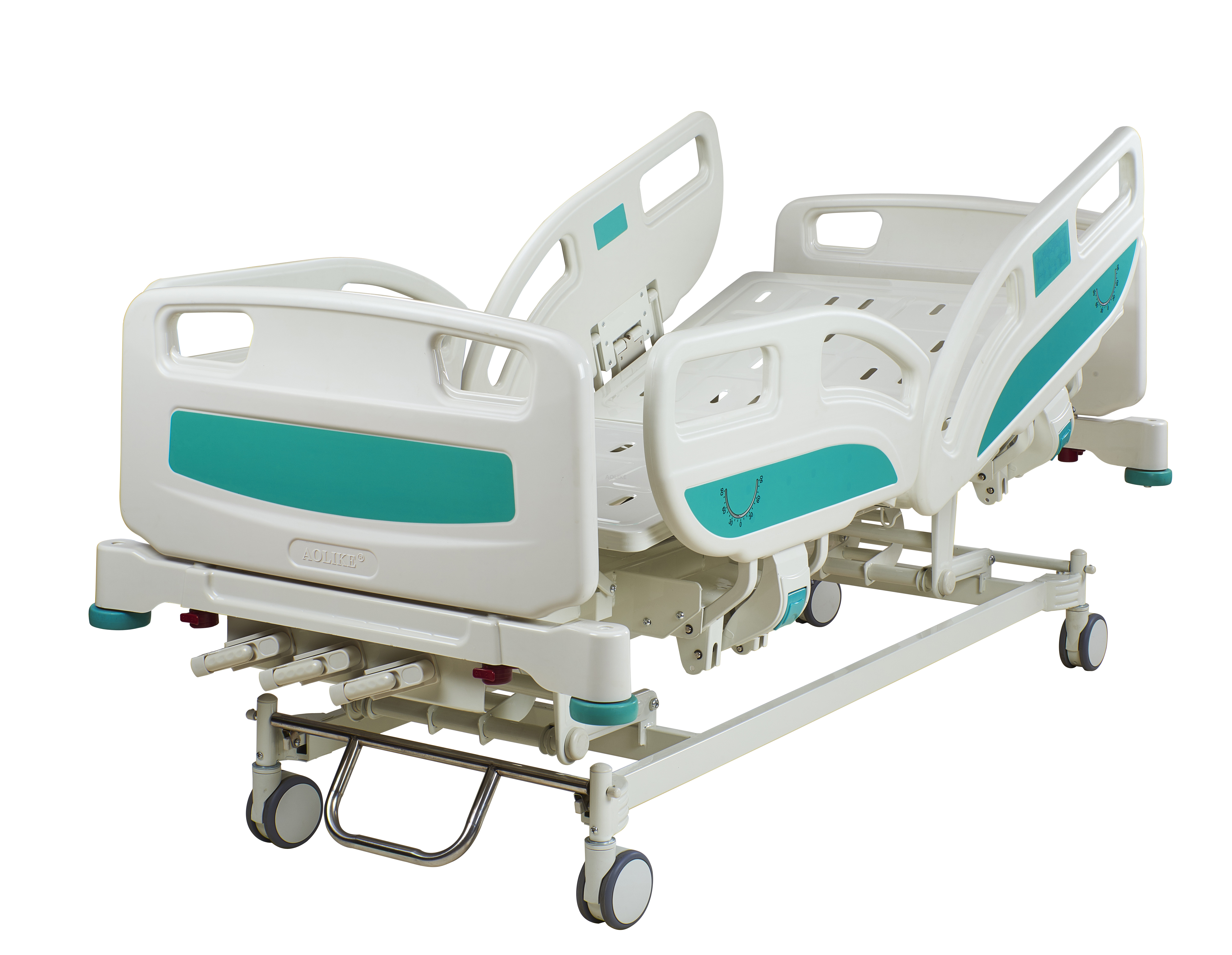
Manual hospital beds use mechanical crank systems for selected adjustments. They may be suitable for general wards, clinics and nursing facilities where a simple and cost-conscious configuration is required.
Typical considerations include:
Mechanical backrest and leg-section adjustment
Simple structure and operation
Maintenance requirements for crank and moving parts
Suitability for the intended ward or facility application

Electric hospital beds use motors and controls to support selected position adjustments. Functions and available options vary by model.
Common available functions may include:
Backrest adjustment
Leg-section adjustment
Height adjustment
Chair position or selected positioning functions
Buyers should confirm power-supply requirements, control options, safe working load, accessories and maintenance needs for the selected model.

ICU hospital beds are designed for intensive-care and critical-care environments. Required functions depend on clinical procedures, facility requirements and the selected model configuration.
Typical available features may include:
Multiple electric adjustment functions
Patient-positioning controls
Safety side rails
Emergency positioning functions
Higher safe working load options
ICU hospital beds may be used in intensive-care units, emergency departments and other critical-care areas.
Before purchasing hospital beds, buyers should compare model-specific functions and confirm which features are required for the intended application.
Adjustment functions affect patient positioning and caregiver operation. Common configurations include:
Two-function hospital beds
Three-function hospital beds
Five-function electric or ICU hospital beds
The appropriate configuration depends on the care environment, intended users and required procedures.
Buyers should evaluate safety features available for the selected model, including:
Stable bed-frame design
Side rail design and operation
Castor and braking systems
Emergency functions, where applicable
Different patients and facilities may require different load capacities and bed dimensions. Buyers should confirm:
Safe working load
Mattress-platform size
Overall bed dimensions
Frame structure and accessory compatibility
Choosing a suitable manufacturer is as important as selecting the product. Buyers should evaluate manufacturing capability, documentation support and communication before confirming an order.
When evaluating a supplier, buyers may review:
Relevant product-development capability
Production facilities and manufacturing processes
Quality-control and inspection procedures
Technical communication and export-project support
For distributors and healthcare projects, customization may be required. Available OEM/ODM services may include:
Selected product-configuration adjustments
Color and material options
Logo branding and private-label projects
Packaging requirements
Selected accessories or product appearance options
Customization feasibility should be confirmed according to the selected model, technical requirements and order quantity.
International buyers should request applicable documentation according to the selected model and destination market.
Relevant information may include:
Product specifications and technical parameters
Operating instructions and packing information
Applicable compliance documentation for the selected model
Model-specific document verification for destination-market requirements
Hospital beds are long-term healthcare investments. Buyers should evaluate not only the product, but also the supplier’s communication, delivery planning, spare-parts coordination and after-sales support.
Before placing an order, buyers should confirm:
Product suitability and model-specific specifications
Manufacturing capability and quality-control information
MOQ, sample availability and production lead time
Packing, container loading and shipping support
Technical communication, spare parts and after-sales support
Confirm the intended application: hospital ward, ICU, nursing facility, rehabilitation center or home care.
Confirm the required functions, safe working load, dimensions and accessory requirements.
Request a model-specific specification sheet and quotation.
Verify applicable documentation for the selected model and target market.
Confirm MOQ, production lead time, packaging and shipping requirements.
Discuss customization, spare parts and after-sales support before placing a bulk order.
The suitable bed type depends on patient needs, facility procedures and budget. General wards may use manual or electric hospital beds, while models with additional positioning functions may be required for more complex care needs.
Provide the required bed type, functions, quantity, destination country and any customization requirements. This helps confirm suitable models, documentation, packing and delivery details.
Customization may be available for selected models. Options can include configuration, colors, accessories, branding and packaging, subject to technical feasibility and order quantity.
Selecting the right hospital bed requires careful consideration of application needs, product functions, safety requirements, technical documentation and supplier capability.
AOLIKE supplies hospital beds, hospital furniture and rehabilitation equipment for global healthcare buyers, distributors and medical projects. Contact us with your required functions, quantity and destination market to request a model-specific recommendation and quotation.